An MBA Group’s Immersive Experience in Vietnam
Blog Strategy
- How real-world immersion transforms academic concepts into deeper, more grounded understanding.
- Why recognizing the human side of global systems is essential to truly understanding how they function
There is a moment that emerges in many global programs quiet, unplanned, and easy to miss. It is when students begin to move beyond analysis and start to truly observe what is in front of them. For the MBA group from MSU Denver, that shift took place inside a seafood processing facility in Cần Thơ. Surrounded by the steady rhythm of production lines workers in white coats and blue hairnets moving with precision the environment felt less like a site visit and more like a continuation of the classroom in a different form. In that space, learning became tangible.
From Case Study to
Context
Before arriving in
Vietnam,
Caseamex was understood through a familiar academic lens: a company
profile, an example of export-led growth, a case of supply chain efficiency
within a global market.
Being on-site
introduced a more nuanced perspective.
Beyond its scale as a
seafood exporter, Caseamex reflected the depth of local expertise that
underpins Vietnam’s participation in global value chains. The systems,
workflows, and coordination observed on the factory floor pointed not only to
efficiency, but to the accumulation of knowledge, discipline, and adaptation
over time.
What had previously been conceptual became
contextual.
Write your awesome label here.
While the operational scale was significant, it was the human interactions that shaped the experience most deeply. The visit was marked by a sense of openness from initial discussions to time spent on the factory floor. Small moments of acknowledgment between workers and student's brief smiles, gestures, shared presence added an important layer to the learning experience. For many students, this reframed how they viewed labor and production. What is often reduced to metrics or processes in academic settings became connected to individuals and communities. This human dimension is not easily captured in case studies, yet it is central to understanding how systems function in practice.
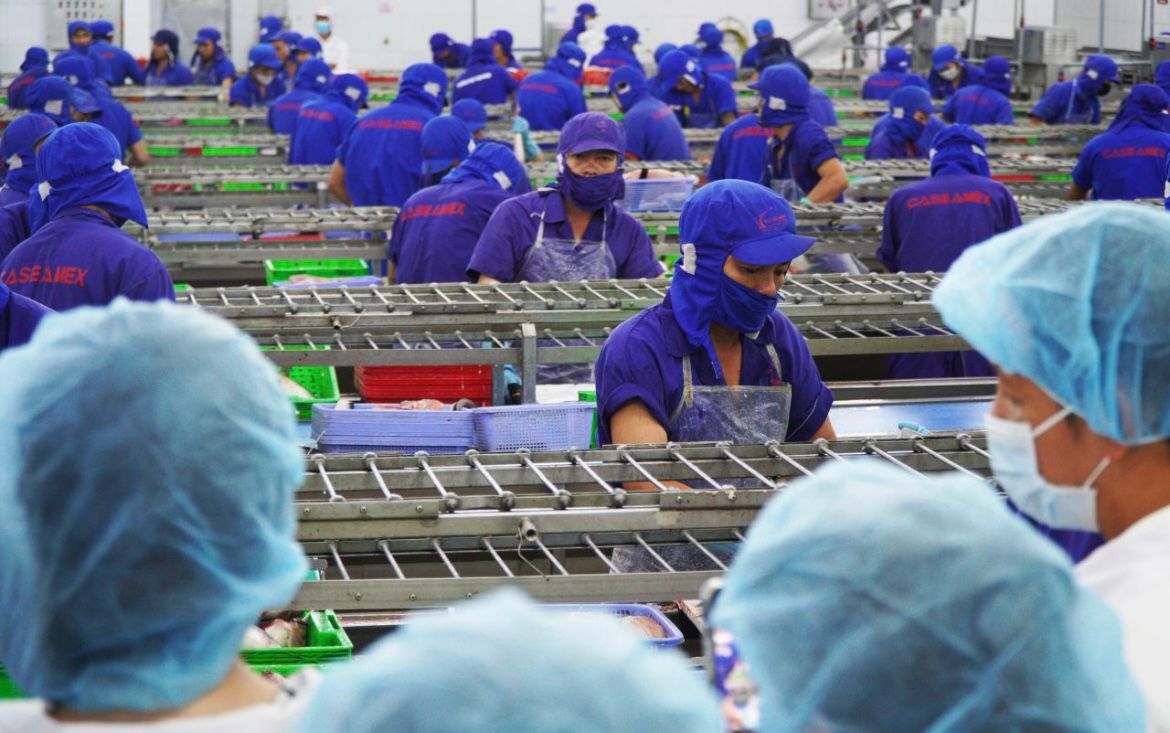
There is often a subtle point during immersive experiences when engagement deepens. Questions become more thoughtful. Observation becomes more intentional. The need to document gives way to the desire to understand. By the end of the visit, this shift was evident. Students had not only observed how international standards are implemented and maintained but had also begun to grasp the complexity behind those systems. One student reflected afterward: “You can study supply chains all day… but this is the first time it actually made sense.” It is a simple statement, but it captures the value of experiential learning—where knowledge is not only acquired but grounded in real-world context.
Dang H. Huynh is an experienced Program and Partnership Manager specializing in international education, cross-cultural engagement, and global learning initiatives. Over the past three years, Dang has played a key role in supporting and expanding the EPICS (Engineering Projects in Community Service) programs in the region. Starting from Vietnam and more recently in Indonesia, he has helped facilitate partnerships between local universities, communities, and international institutions, enabling students to work on real-world, community-driven projects that create tangible social impact.
Dang Huynh, BA
Operations Mnager, Southeast Asia
Recommended other articles
Explore our Engineering Programs
Solutions for universities

COPYRIGHT © 2026 GLOBAL ENGAGEMENT INSTITUTE. ALL RIGHTS RESERVED.